Interview / Maxim Gorki Theater / Version 3
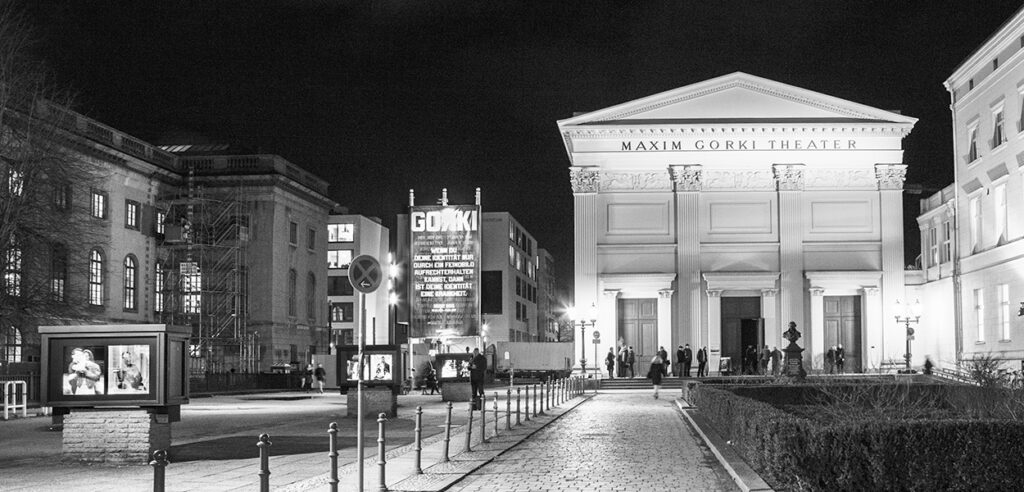
The Maxim Gorki Theater is the smallest of Berlin’s ensemble theaters, located on the boulevard Unter den Linden in the heart of the city. Shermin Langhoff and Jens Hillje have been the artistic directors of the Gorki since the 2013/2014 season. The institution is shaped by an 18-member international ensemble, the four resident directors Nurkan Erpulat, Sebastian Nübling, Yael Ronen, and Hakan Savaş Mican, the in-house author Marianna Salzmann, and approximately 160 additional staff members. The repertoire on the main stage, as well as that of Studio Я, reflects Berlin as a zone of conflict—where questions of identity are contested, where people resist imposed labels, and where diversity is demanded.
Version: Shermin Langhoff coined the term “post-migrant theater”. This term is now widely used in other contexts as well, but what exactly do you mean by it?
Necati Öziri: At Ballhaus Naunynstraße, we actually used that term a lot. As in Jean-François Lyotard’s essay What is postmodernism?, “post” signifies the after, i.e. after migration, and also for the against, in order to make it clear at the same time that the people we refer to here as post-migrants are no longer migrants. But that was always meant with a wink, a self-labeling to make it clear that before you label us, we’d rather label ourselves and in doing so we could access funding and so on. So it was a combative term, but also carried an ironic tone. Later, at the Gorki, we began to feel that the label no longer really fit—that we needed to go a step further. Whether you say post-migrants or new Germans, you’re still marking something. We’re simply a theater that reflects this city—a municipal theater that represents Berlin in all its diversity. That’s it.
Esra Küçük: That’s also a question of hegemony. Like you just said: “Who gets to label whom?” Yes, we used the term deliberately, but in practice, everything we do here is German theater—Berlin theater. At the core, it’s about having the self-confidence and self-understanding to say: every story we tell here is a German story, a Berlin story—it’s connected to all of us. At the same time, it’s about giving a platform to people who are underrepresented elsewhere. Like you said, it began as a fighting term because these were representation battles. The question of how cultural representation is distributed in a city or a country is really about amplifying the voices that often go unheard. At Studio Я, we focus on marginalized perspectives—and not just migrant ones. The “post” points to a society in transformation, and holds up a mirror: Look, we mean everyone, not just a few.
Necati Öziri: We also wanted to expose the racism present in cultural institutions and state-run organizations—to counteract it.
Esra Küçük: I think it’s also about dynamics. Post-migrant studies look at why change is so rarely acknowledged—why society still clings to this homogenous self-image rather than embracing the reality of a society that is constantly evolving because migration is a permanent process.
Version: The energy and political dimension of Gorki remind me of Brecht and Weill’s epic theater in interwar Berlin. Do you see any analogies in terms of moral responsibility or historical continuity?
Necati Öziri: You mean how we position ourselves in relation to Berlin’s theater tradition? I think it’s impossible not to act accordingly. And even more so when you consider our surroundings—they’re heavily charged, historically layered. We’re constantly engaging with that context. We had a big festival here, Europe 14|14 (2014), dedicated to the First World War. The announcement that the German Empire was entering the war happened just outside, in front of the palace. You can’t ignore Berlin’s history—and we try not to.
Esra Küçük: When we say post-migrant, it immediately suggests that we’re talking about migrants—and to put it bluntly, that triggers images of “Kanak theater” [a reclaimed slur used for Turkish-German working-class culture]. But in reality, you might describe the authors at our theater more as Jewish women playwrights. People like Sibylle Berg, Sasha Marianna Salzmann, or Olga Grjasnowa. After all, it is also their voices that can be heard here.
Necati Öziri: And right now, for instance, we’re staging Brecht. We’re rehearsing Im Dickicht der Städte. It’s interesting how much projection comes our way. Sure, maybe our ensemble is more diverse—but also, maybe not. That it’s such a hype is honestly a bit weird.
Version: But you also offer that space for projection—with concepts or actions like Flüchtlinge fressen from the Center for Political Beauty, which then get amplified by the media. I find that problematic. These days, the dividing lines in society aren’t between migrants and non-migrants.
Necati Öziri: Exactly. It’s not about hair color anymore—it’s about whether you support or oppose an open society. Sure, you could argue we create that projection space ourselves, but a lot is also projected onto us—at least when it comes to the main house. We also produce traditional municipal theater pieces. But we always ask ourselves: what does this have to do with the here and now?
Esra Küçük: The fact that we take history and what’s happening around us politically and personally—and that we take a stance on it—that’s reflected in the artistic work. And I think that’s what provokes certain responses to our theater. There’s this question: are we allowed to be this political as an institution? Or should art sometimes just be art?
Version: But as long as the political remains within the realm of art—within the aesthetic sphere—not only is everything allowed, but it’s also heavily funded and sponsored. I just wonder where the consequences of political art are for politics? Dubious corporations sponsor biennials and major exhibitions tackling these very issues—to flaunt their sovereignty and enlightenment. That’s how I see it with state-funded institutions, too—they’re still part of a law-preserving state structure. Doesn’t critical art risk becoming a moral fig leaf for politics?
Necati Öziri: These are now two different aspects. One is the art space, which will always remain art space. Sure, sometimes we’ll write a letter to the Chancellor or start a petition—but essentially, we’re making art. And in Adorno’s words: art relocates utopia to the fictional realm, which makes it complicit with society. That’s a criticism you can always direct at art—because it isn’t politics. The second issue is the cultural policy framework—defined, of course by the conditions, by donors and also by the state. Germany is incredibly wealthy and privileged—and at the same time, it exports an unbelievable amount of weapons. There’s no way out of that. It’s a dilemma, and we’re aware of it.
Esra Küçük: I see the current situation differently. If you look at what’s happening in society right now, artists and cultural workers are always the first to be targeted when an open society comes under threat. Just look at our neighbors: Poland, Hungary—even Turkey. It’s artists and cultural colleagues who are among the first to come under pressure when the structures you mentioned begin to collapse. If we’d had this conversation five years ago, I’d have agreed with you. But I think we’re in a different situation now.
Necati Öziri: Nevertheless, we can ask ourselves: how sustainable is what many people are doing right now? At the moment, there are hundreds of refugee projects in the German theater landscape, and of course, the question is what happens after that. We try to think long-term, more sustainably. We’re constantly exploring the boundaries between art, politics, and activism—like in the work of the Center for Political Beauty or our Exile Ensemble, which is clearly designed with sustainability in mind. For two years, we’re training people so they can find their own path, get to know the German theater scene, and tour across the country. Especially in Studio Я, we focus heavily on developing emerging talent. It’s about creating points of identification. I think one of the most important things art can do is move people emotionally—to create empathy and closeness.
Version: What role does the artistic-aesthetic side play in communicating political content? What kinds of aesthetics and artistic practices are you developing?
Necati Öziri: Personally, I don’t believe in a separation between form and content. I always see the two as dialectically linked. And of course, a formal approach can be just as political as a content-driven statement on stage. That really comes through in the individual styles of the directors. It’s not like our house is united by one genre, but there is a gravitational point in terms of content, namely: What does this have to do with the here and now? That’s the first question we ask every director who wants to stage something with us: Why this material? Why this cast? Why at this house, with this ensemble, that speaks this language, can sing these songs, and so on? And from there, arguments automatically arise and a kind of overall structure emerges, a bit like a social sculpture.
Esra Küçük: When we use the word “political,” it doesn’t mean we’re doing theater about politics. I believe that everything we do is political. If you ask a pastor whether he can separate the religious from the aesthetic, he’ll say: “No, that’s my whole view of society, of life, of the world.” We don’t draw a line between the aesthetic and the political—it’s more about the perspective you choose to take.
Necati Öziri: It’s about the structural order, the power structure, or the hierarchy that organizes a space or society. That’s why political theater starts with questions like: What do the restrooms look like? What does it look like backstage? What does the space in front of the stage look like? How can I create situations that are different? The political doesn’t just show up on stage—it’s embedded in the underlying hum of everything behind it.
Version: So would you say your aesthetic practice involves working directly with the people on stage to develop the pieces, rather than simply producing a pre-written play?
Necati Öziri: We are always looking for points of contact between us today and the material and if you have the rule, so to speak, that we don’t talk about others, but the so-called others talk themselves, then that often leads to very personal evenings. That’s often how those so-called typical Gorki monologues come about. There are actors who don’t just want to play a role—they want to be part of the authorship, to write their own monologues, at least in part. It’s such a flickering between authenticity and representation. How often do we or our actors get asked: „Is that really you? And are these all real stories?“
Esra Küçük: Of course, it varies from one director to the next. But take Yael Ronen, for example—she develops her pieces together with the ensemble. A play like Common Ground, which deals with the conflict in the former Yugoslavia, could never have come about in any other way.
Version: The multilingual nature of your plays is interesting.
Necati Öziri: That’s definitely a big challenge at a German-speaking theater—working with so many people whose first language isn’t German, or who, like our Exile Ensemble, may not speak German at all yet. And still, everyone in the audience needs to be able to follow the play. It’s about developing ways of playing in which you stand on stage with different languages. However, many plays are simply surtitled or, as in Die Schutzbefohlenen by Elfriede Jelinek, the actors translate each other.
Esra Küçük: Talking Straight takes this idea to the extreme. They invented a language that doesn’t exist—they just called it “Foreign Language.” They reenact familiar scenarios like political speeches, conferences, tribunals, or military recruitment sessions. And somehow, you understand everything, even though they’re speaking a made-up, Central European–sounding language the entire time. It’s like when you see an ad in a foreign language and suddenly realize how ridiculous it all is. There’s this alienation effect—maybe that’s the parallel to Brecht’s theater here in Berlin. You stop focusing on what’s being said and start paying attention to how it’s being said. They simulate societal rituals, alienate them, and that makes you start reflecting on the how—and on the power structures behind it.
Version: Through your media presence, you also reach audiences who might not primarily be interested in theater. What kind of audience are you speaking to, and how?
Esra Küçük: Well, in general, looking at the numbers, we can say that we have a very young and diverse audience. With Mely Kiyak before and now Can Dündar, we have two columnists, and myself as a political scientist taking care of the discourse, and a studio that’s not just a small stage, but rather a space where activists and people from this city can find a place. Our ambition is to reach people who have only been living in this city for a day or for a hundred years. Can Dündar’s column, for example, shows how he experiences this city with a fresh perspective—just like the members of the Exile Ensemble, who won’t be on stage to tell exile stories, but to offer their new view of Germany. Of course, these are international biographies, but all of them are connected to this place—and we want to highlight that connection.
Necati Öziri: Overall, we address a relatively large number of communities, and multilingualism is a big issue anyway. We held a writing workshop where people wrote in Arabic, Persian, Turkish, and Albanian—and it worked beautifully. Currently, there’s a performance happening in the studio that’s entirely in Polish. Another show is in rehearsal now, telling Iranian fairy tales in Persian. At the start of next season, we’ll premiere a piece in Arabic, and with The Situation, we have a full-on language mix on the main stage. That piece was just invited to the Mülheimer Theatertage, as the first non-German-language work in the selection. Esra’s forum uses French, English, Turkish, and German. It’s just second nature for us, and maybe that’s why it resonates beyond borders, even though we’re not always talking explicitly about other countries.
Version: I’d like to return to the Flüchtlinge fressen action by the Center for Political Beauty last summer. Many found that action quite cynical. Some people may have been drawn to it out of pure voyeurism or sensationalism rather than political urgency. How do you deal with that kind of criticism?
Necati Öziri: The action plays precisely with that line—being problematic and cynical—and with the blurred boundaries between art and politics, between reality and fiction, and with transgressions of all kinds. So I completely understand why people would take issue with it. Here in our house, it’s something we discussed very critically. Some found it brilliant, others found it more troubling—but that’s exactly the kind of space we want to create here. That doesn’t mean we all agree or find the same things exciting. It’s like the Böhmermann affair and that controversial poem Schmähgedicht —whatever you think of it, I think it’s the spirit of the times to address this issue.
Esra Küçük: I think the reason the media response was so big is because they’ve mastered something that many others struggle with: they use the digital stage in a way that hardly any other artist collective does. Their technical know-how, their expertise, the formats and platforms they use—it’s all very well connected and gives them a much, much wider reach. So sure, you can ask: what were people expecting? That someone would actually be eaten? What are people surprised about if, in the end, nothing happens?
Necati Öziri: Their strategy is very clear. There’s a legal, formal, legislative boundary—and they cross it, justifying it with a moral and ethical stance. Sure, it’s a legal offense, a crime even, but they argue it’s morally justified because the law itself permits much worse things. It is precisely about questioning what is formally possible. So yes, it plays with laws, and that can come across as cynical. Eye for an eye, tooth for a tooth. You kill over there, we’ll let someone be eaten over here. That’s the game—completely ignoring the norms, customs, and laws of society. And despite all the criticism about voyeurism, I think that’s powerful.
Esra Küçük: And despite the issues I have with the project—like how it sometimes speaks about others instead of reflecting on itself—it’s still fascinating how often the question gets asked: is this still art? And I’d argue yes, absolutely. This is still art.
Xenia Sircar: People who came just to see the tigers ended up having real conversations. There was an open mic where anyone could speak. It became a true moment of public dialogue, an open agora where citizens came together to exchange thoughts on an important issue. That, in itself, was the theater piece.
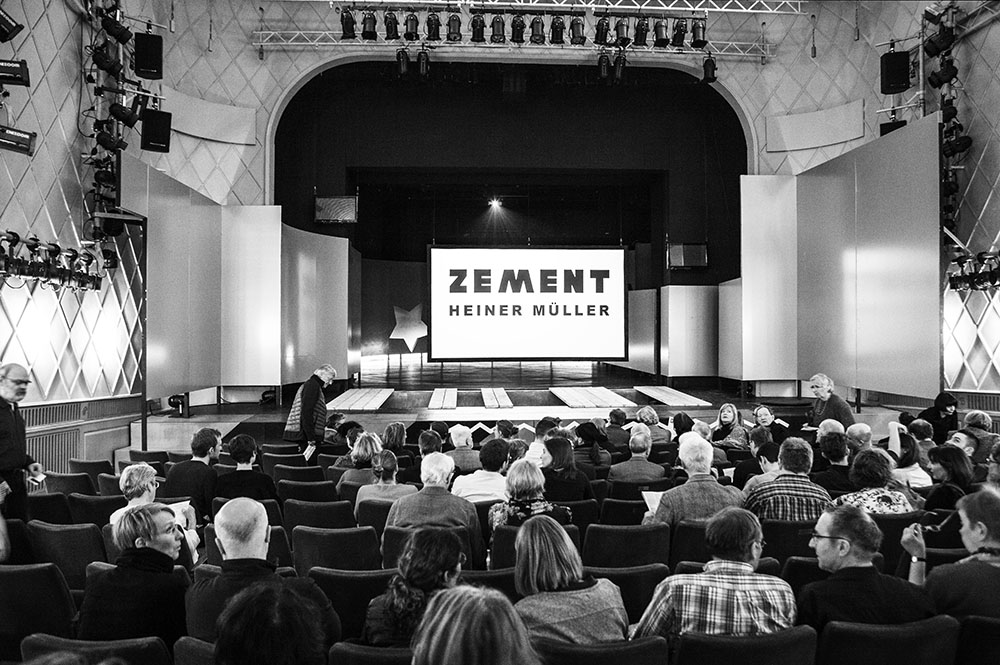
Version: The action was part of the program of the main stage, where you also present classical repertoire theater with a fixed ensemble and pieces by Chekhov, Shakespeare and Heiner Müller all with a focus on the present. What role does Studio Я play in the overall concept?
Necati Öziri: Studio Я functions institutionally in a different way. It’s kind of like a small theater within a theater, so to speak, although it shares the infrastructure, rehearsal rooms, technology and so on, and of course there are also personnel overlaps. But still, Studio Я is its own entity—with its own programming, its own curators, and no permanent ensemble. It has external funding, so in principle it is an off-scene stage that applies for projects and binds artists from Berlin’s off-scene to the house. There’s a lot of discourse, lots of concerts, music, and a thousand small experimental intermediate formats. For instance, we have a format called Theater ist endlich ist Theater. Over 24 hours, people come together—directors, writers, audiences, and actors. At midnight the writers begin writing until 8 AM. Then the directors rehearse from 8 AM to 8 PM. Then all the premieres follow one after the other. And so there is a space down there that stands for something politically and has a programmatic profile.
Version: And who decides on this programming? Is there a jury?
Necati Öziri: I’m the artistic director of Studio Я, and Tobias Herzberg is the dramaturge. We also have multiple curators for specific program areas. What’s interesting is that everyone knows each other, keeps an eye on each other’s work, and everyone is aware that we’re shaping this space together—this Studio Я.
Version: So the decision-making process is still somewhat hierarchical?
Esra Küçük: Well, theater is definitely a hierarchical space by nature.
Necati Öziri: When Shermin Langhoff was appointed artistic director here, she immediately chose to break with that and not be the sole director. She brought in Jens Hillje to share the role. So from the start, it was a leadership collective.
Version: Have you made any attempts to make this more participatory?
Necati Öziri: In Studio Я there are curators who should and must have a say, it’s a network. Of course, we try to keep an overview so that things don’t duplicate each other and help make decisions, but the power, or let’s put it this way, the decisions are already spread across many shoulders, otherwise it wouldn’t be feasible. We almost never have a classic division of labor in the studio, because we always develop the pieces together. It’s a bit different on the main stage, of course, but even there, we have lots of content-based discussion spaces—weekly dramaturgy meetings and even retreats. What’s important for me to say is that everything we do here is part of an ongoing search. A new path is being taken here that has not yet been completed. It will only be complete when all of this is no longer needed, when everything we have just told you no longer needs to be told.
Version: But this search, this dynamic, has to keep evolving. Institutions have a tendency to solidify certain structures and positions, especially when, like you, they become successful. You can only prevent this if you constantly question yourself as an institution and the structures in which you operate.
Esra Küçük: Exactly, and that self-questioning is crucial. When Jens and Shermin started here three and a half years ago, they saw themselves as coming from the back row, suddenly stepping into a state theater. Then they worked hard, and suddenly it was the Theater of the Year and then Theater of the Year again. So you can’t keep operating like you’re still the underdogs. You have to deal with that shift and reflect critically. It’s a mix of luck and growing pains. We’re tackling that very concretely through a project in my department called Junger Rat. A year ago, we brought eighteen young people into the house, and their main job is to critique us and ask: “What does what you’re doing here have to do with us?” And at their best. These are people who don’t mince their words and challenge us.
Necati Öziri: It’s all about staying dynamic and on the move and not getting stuck, establishing yourself and claiming: now we’ve done it, now we’ve made it!