Interview / Cana Bilir-Meier, Belit Sağ / Version 3
Documentaristics – Documentation and their Characteristics
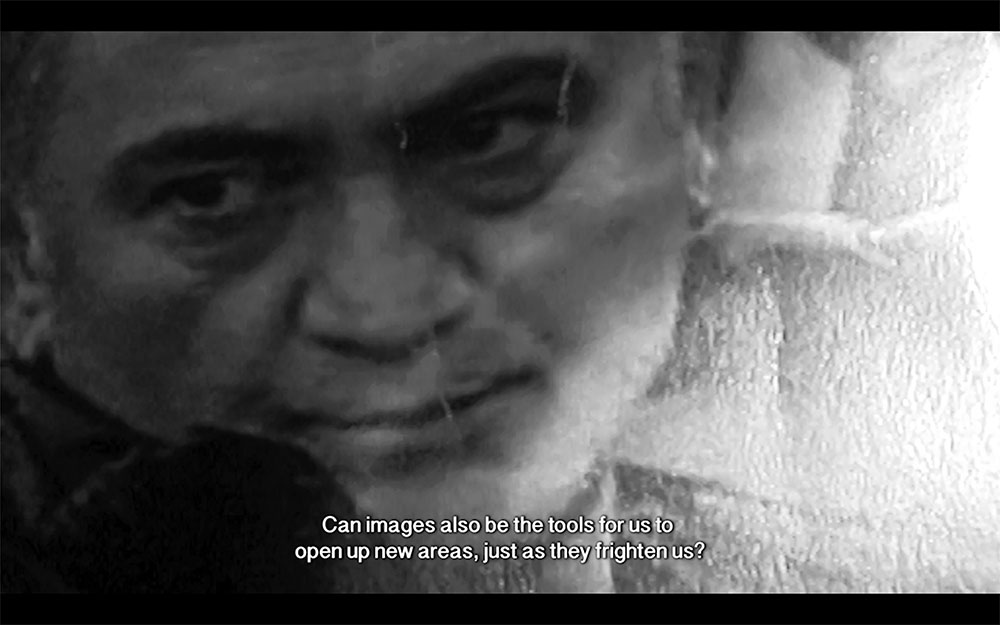
Cana: In your films, especially Ayhan and me, you pose a lot of questions—vocalized and loud—like: “Can images be the tools for us to open up new areas, at the same time as they frighten us?” or “Can an image capture one’s soul?” “Can I control someone by capturing his/her image?” “Is censorship something that regards my practice as speech?”
belit: Through these questions I think about images. My issue is the impact of images, namely images of conflict or images of violence. Images can be images of violence, but they can become violent themselves. I’m trying to grasp and understand what they do. Each work is trying to approach the issue from different perspectives; these questions are not to be answered, but should open up more questions. Images can be the tools for us to open up new areas, as they can frighten us. That’s actually what I’m trying to do, finding ways that images can open up areas for us. How can we create different types of images that could take a position and open up discussions? How can we create new information through images, not just factual ones like, for example, the age of a person, his/her origin, his/her story … but more his/her experience? How is life in war, or what are its images, how can we use images to pass on experience? I mean a kind of information based on visual images.
Cana: Would you say your motivation to make videos is rooted in the fact that at the moment there are many more video images of war than before?
belit: I think the topics of the videos are caused by the violent images we see more and more, but that’s not the reason why I’m making videos. I think my passion to work with images comes from my past, from my video activism in Turkey.
Since 2000, I have been involved in different video activist groups in Ankara. I was a student in Ankara, where I followed the classes of sociologist and philosopher Ulus Baker at Gisam. Gisam Audiovisual Research Center is a department in ODTÜ / Ankara, a technical university without a fine arts department. We started forming different groups, by combining image making, philosophy, sociology, and activism. In the beginning we didn’t know anything. We just started recording actions on the street. We were on the streets before, but then we started to record. We followed different groups, like: queer groups, human rights actions, Kurdish groups, objectors of military services, all kinds of topics, whatever happened on the streets in Ankara. We got in touch with different groups and started to follow their cases, like court cases in different cities, or other activities. We tried to create a visual archive. We started practicing a sort of video activism and started to ask questions. It makes a difference how you hold the camera, or from what position: if you stay next to the press, next to the cops, or next to the activists. Through positioning yourself, through asking yourself these questions, you start to understand what it means to make images and what kind of images you want to make, and what they mean. We also … we were attacked by the police when we stood next to the activists for example, when we insisted on being there.
First we started VideA, a video collective, and later on karahaber, which is a video-activism atelier. With karahaber we started thinking about how to distribute the videos. Karahaber means “Black News.” We spread alternative news that we put online immediately, as fast as possible. We also produced DVDs and CDs. It was very important to be in the underground, to talk to people and give first hand information, and we started making interviews. The motivation has never been to make artworks. Many things were done anonymously and people were not trying to make any sort of a career. We were trying to find different ways of working with images or videos. We were activists first, and we were using video. For us, it was important to bring out issues and talk about them. It was important to figure out how to create a kind of image that is as little mediated as possible, images that talk about marginalized people and try to de-marginalize them. Our understanding of conflicts is also largely rooted in images. We think through images,––I still do.
Cana: If we think through images, how could we approach someone’s history, someone’s biography, someone’s marginalized, stress-filled life without appropriating it? I asked myself this question when I produced Semra Ertan. How could I make someone visible without abusing her history for any advantage? Since she wasn’t alive anymore, she could not tell me how I should do the film. One solution could have been not to show her, but then her story would have been forgotten. Where is the border, what are the difficulties, what are the dangers of what we are doing? All art is political, but we deal in our works with questions of visibility, with the representation of visibility, representation of responsibility. I read Johanna Schaffer’s book, I think it was Ambivalenzen der Sichtbarkeit, where she discusses the contradictions within political demands for greater visibility using the logic of representation. I think it’s interesting how she demands that one think about the act to make somebody visible. A feminism whose target is to visualize women, to represent them in their political and social functions, says nothing about power and inequality. I want to reflect visibility as an ambiguous category and not as a demand for itself. Invisibility can also protect marginalized groups and help them act independently. Someone, or a group, who is seen can be controlled more easily, even without someone controlling him/her/it.
belit: In whatever I’m doing I’m trying to position myself. It’s important where I’m coming from, why I’m interested in this issue and what I will do with it. And I’m trying to make it transparent. It’s always me who is editing and formulating the work, and it’s important to reveal that it’s me standing behind the work. Shopping around, going from one conflict or issue to the other, is problematic. And I believe invisibility can also be a very good tactic for movements. Visibility was our tactic then, but there were also many groups that demanded invisibility and we didn‘t film or show them. It‘s important to have diversity of tactics.
Cana: Yes, when putting your own stance into a context, as well as inside a discussion, it’s really important to clarify from where you speak and to whom you address. For example, I researched migration in Germany, as well as Turkish history of the ‘60s, when my grandparents came as guest workers. I started to work with the archive of my family and research existing archives. There is one that was founded in the ‘80s by migrant activists in Cologne, Germany. They started in a garage, collecting the history of Turkish migration, later Italian, and so on. If you look today, thirty to forty years later, it is institutionalized—the government gives them space and funds—and in the highest positions there are almost no migrants. How do we remember? Who gains advantages from remembering? Remembering is an unfinished process and fragmented in itself. And it’s highly linked to writing a certain kind of history in the form of reconstruction—a process of adding a new story—and it’s important who writes it, who collects it, who is speaking, who can enter it and how can it be used? It reminds me of Jorge Luis Borges who says that when one tries to collect and portray the whole world by putting together artifacts, when one dies in the end, one realizes that one has collected one’s own portrait.
belit: How can we transform the archive? I‘m involved in bak.ma and our question was how to make an archive that is dynamic, that people can use, contribute to, and search in different ways. One that is as accessible as possible. We used an open-source program, cooperating with two programmers from Germany. Over the years, we collected so many tapes and digital files—all these things collecting dust on the shelves or inside hard drives. There was a need for us to put them somewhere and make them accessible. An archive has to be as dynamic as life. A personal archive has a lot of different characteristics, definitely every work one does, first and foremost, talks about that person, definitely.
Cana: Another question I am dealing with is the border between yourself and the other. While developing a project, you are filming, you see the news on television, you look at yourself, you talk to people, and you have the archive and memory. After a while everything gets mixed. You are playing with different points of view. For me, making films or writing texts is never something complete. I don‘t like to point a situation in an educational way, or worse, to show someone else a mirror, because I don’t want to feel, or present myself as, all-knowing. My films or works are more like screenshots of a certain point in my thought or observation, always ongoing and developing. I like the idea of showing something in process or unfinished because grappling with a subject is not over after a film or an artwork is finished, it develops. In the beginning there is always the passion for an issue,— a research—out of which the form develops, and then perhaps a film.
belit: We position ourselves in different roles: we become the audience, then the producers, and so on. That’s exactly the point. There are no borders between those positions anymore. They are all mixed into one moment. I’m generating my own personal archives, especially, for example, in and the image gazes back. When I was doing research for this film, I watched the James Foley execution video and the film Seven and thought of how filmmakers are at once consumers and producers of this image culture. We look at those films in a way that is challenged by the information we get about them. That is also a breaking point. The video talks about these different positions. I’m trying to understand this, so the video becomes my thinking process. The video of James Foley’s execution by ISIS is a very well shot, smoothly edited video, with two camera angles and a microphone, and a super-articulated talk. I saw parts of the online video and a couple of days later read an article in the Financial Times in which this video was compared to a movie from 1995, a well-known Hollywood movie called Seven by David Fincher. I took a screen shot from the film’s last scene and an image of the execution and put them together. They were shockingly alike. It would be too easy to say that the makers of the ISIS video saw Seven and decided to remake exactly the same image. It’s a lot more complex. It’s not like someone is playing a violent video game and then goes out to kill someone, and once we ban the video games, it is all solved. This is oversimplification and does not help us understand how images work. This doesn’t mean that they didn’t watch that film, but it means that we, in different degrees, have the ability to––consciously or unconsciously––recreate what we have seen. We, as viewers, are makers of that image culture that we define and control. And also, these images come with a caption, a reading of them by someone, and we have to rephrase those captions and reread the images by ourselves.
Cana: The question is: “What do we see as a violent image and what do we not?” Of course an execution is a violent image, it’s the most violent image that we can imagine, but it’s not that easy to just say “This is violence.” The definition of a violent image must be thought of more. How do we define violent images?
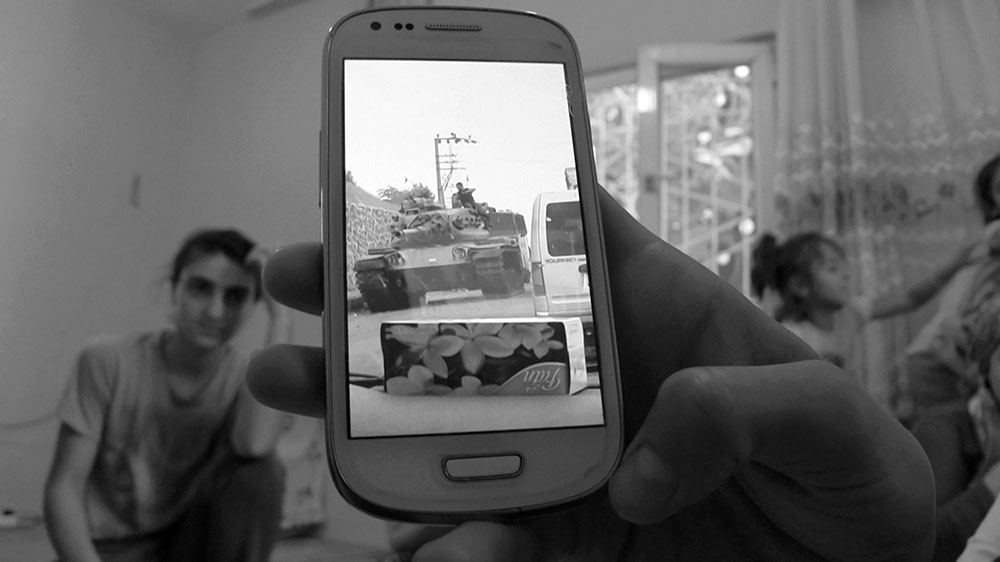
belit: In the video Sept.-Oct. 2015, Cizre, I used cellphone images that people from Cizre showed me. I put everything they showed me in the video except for two images because they were violent in a different way, and open up different questions that need to be examined in a different work, maybe. One was the leg of a child; an explosion had cut through it and there was blood. The second one was of an open fridge and there was something inside, but you didn’t know what it was. I didn’t include it because I knew that it was the body of a nine-year-old girl killed by Turkish security forces. Her family wrapped her body and put it into the fridge to preserve it until the curfew ended and they could go out and bury the body. When you look at this image, and don’t know the story behind it, it’s just an image of a fridge with something inside. But if you know the story the image is extremely violent, a lot more violent than seeing blood. Because it is in your imagination that you start understanding the situation wherein someone has had to put the body of his or her child in a fridge. It’s the “invisible” violence that becomes a lot bigger in your imagination as you think about it—you grasp a lot more through that image. The video I was making was about daily life images from a domestic environment in a warzone, and the violence of that suspension. The image of the body in the fridge is something that keeps coming back to me, and talks about another part of war, and its images. It is a very powerful image.
Contemplation or connecting on a personal level and creating stories and voices is such an important thing. How do you apply sound and text in your work, Cana?
Cana: I like to separate text and image in my works. For example, with Prolog Yorgun Savaşçı I was dealing with letters that I wrote with different protagonists and also friends supporting the research process. Most of the time I have the texts first, which inspire the images I create. In Ein Raum mit Bildern von Provinzen/A space with images of provinces there is a voiceover of a girl that I recorded while she was playing. She invents her own fictive stories with sentences like: “The owl is so old that it even touches the ground.” Her phantasy encouraged me to produce the images. Sound and image don’t have to illustrate each other by force, but they can enrich each other. A voiceover is rooted in reportage, actually, and it is interesting to play with. I use it more in the sense of a diary, which is a very personal view.
belit: I’m thinking about voice quite a lot and I’m thinking how else could it be used, besides voiceover in a video. How it could be part of the video, how it could be more than just voice. I really put it together with the images. I have a couple of sentences—I write small, small things—and then put them on the timeline to see them and then I change them, again and again … the image develops. I don’t know what I’m doing in the beginning. The image reminds me of something and then I add some words. I do take small sections of sound just to try out how it works and make the final recording in the end. It happens that I change everything in the end. I can’t manage it otherwise. So the distance between the image and the words creates a space of imagination. I like your experience with the distance. It gets really close and then far away and this change in approximation makes your work.
Cana: A last point I would like to talk about is the actual situation for cultural producers in Turkey. Censorship is a traditional control mechanism in Turkey, but now, after the attempted coup, it has reached a new dimension. There is governmental censorship, but self-censorship (for understandable reasons) is also far reaching. Institutions, alternative spaces, activist groups, and/or individual artists are all affected differently. It’s very important to find a balance between how far you can go, or mask a critical point (while not risking everything), and nevertheless continue and resist. Turkey has decided to withdraw from the EU Creative Europe Program, which funds cultural production and exchange. I think that is a really difficult act because it leads to an isolation of Turkish and/or Kurdish artists. This is also a kind of censorship. We cannot separate censorship in Turkey from cultural interaction with Europe and I wish there would be, for example, clear statements from these funding institutions to provide this exchange. Also, your work Ayhan and me was censored, already before the attempted coup. Can you explain your situation and approach?
belit: My work Ayhan and me (2016) was censored by a non-governmental, non- state body, Akbank Sanat. This institution is—as its name suggests—funded by a bank, Akbank. I think each censorship case is very different and needs to be examined carefully. In my case, the institute never officially accepted the fact that they were censoring the work (and the exhibition) for political reasons. Therefore, these reasons were never clearly talked about. We know that a pro-government cultural figure is on Akbank Sanat’s board of directors, Hasan Bülent Kahraman, and his close relations to the AKP government already give us some signals as to why my work was censored.
I think the period during which Ayhan and me was censored was when things started getting more and more repressive in Turkey. At that moment, we didn‘t expect the cancellation of a whole exhibition, and it was the first of its kind in Turkey. At the moment, unfortunately, it is not very unexpected if you think about the number of journalists in jail and the number of alternative news sources that have been shut down and biennials cancelled. Also, since then there has been a lot more self-censorship by the artists. I don‘t mean my censorship was the starting point, but it happened at a point where things were escalating rapidly and it was a big sign of this escalation. Self-censorship is a big thing now in the arts and I believe visual artists are trying to find ways to express themselves and understand the limits of their expression—it is a transition period now. By transition period I mean a time when people try to figure out how, and in what ways, they can deal with the pressures under which they need to create. We might need to wait a little to see the products of this period. This transition has happened in many other places in the world. I always give the example of Iranian cinema. Iranian cinema created one of the most wonderful films, under repression, and this gives me hope. Please don‘t get me wrong, I don‘t want to say that we need repression in order to be creative, nor do I want to romanticize the conditions of life under dictatorship because that would be nonsense. Turkey is going through terrible times and for me the only way is to keep producing and staying in solidarity with the different parts of society that fight a similar fight against this dictatorship: be it people living in open war conditions in Kurdistan, and/or people working in different sectors like journalists, academics, construction workers, miners, etc.
As a closing sentence, since this will be published in a magazine in Austria in the EU, I want to pose these two questions: “Who reinforces repression in Turkey?” If our answer is “Erdoğan and the AKP,” then the second question is: “Who supports Erdoğan––financially and by staying silent––outside of Turkey?”