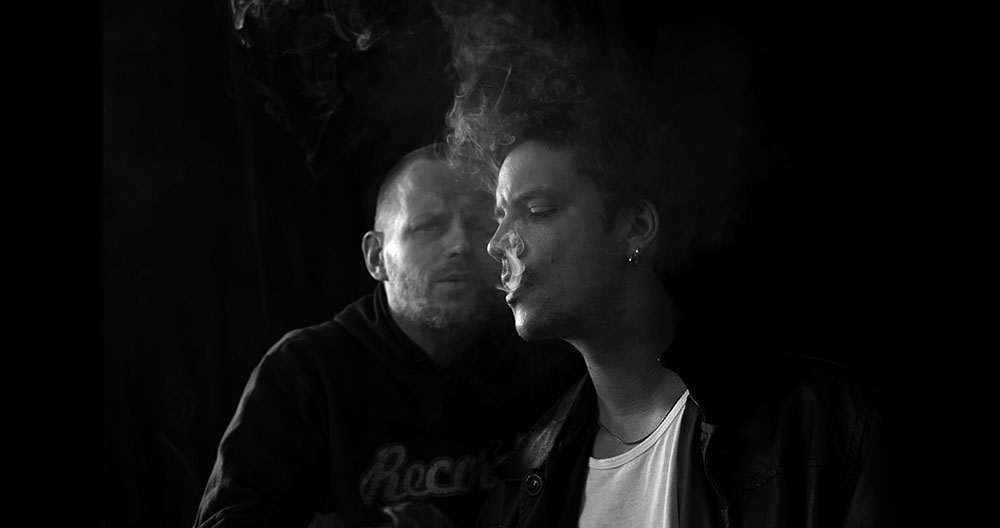
Interview Manfred Grübl / Didi Kern, Philipp Quehenberger / Version 2
Monkey Island
Didi Kern, drummer for Bulbul, Broken Heart Collector, Fuckhead, Wipeout, Die Mäuse, Wenzl Dnatek, and others, feels at home in pretty much any genre—just like keyboardist Philipp Quehenberger (Mego, Sabotage, Laton). When the two come together, they set out to reconcile elements that at first glance seem totally incompatible. Playful electronics meet free jazz, noisy high-intensity textures meet playful melodies, quirky harmonies, and psychedelic sound structures. What they celebrate is a tightrope walk far beyond any conventional musical norms. Their relationship with Franz West was mutually inspiring; over a period of ten years, the artist and the two musicians collaborated on a number of projects.
MG: On one hand, there’s the CD project, and on the other, there’s the club you’re working on—maybe you can talk a little about that?
PQ: Once a month we do Club Egal at Celeste. We invite other people too, just to bring in some synergy and a sense of continuity. The idea is to showcase projects we’re involved in. There are concerts, followed by DJs or sometimes an electronic act. Since both of us have one foot in electronic music and the other in rock or jazz, the challenge is really how to bring those together. The audiences don’t necessarily overlap. You first have to find a pool of people who…
DK: …accept everything. It would just be nice if it could be mixed somehow.
MG: And you’re also releasing a new CD, plus a vinyl release—what direction is that heading in? Where do you see yourselves in this wide musical spectrum?
PQ: We both kind of come from the punk scene, which was, in a way, an underground pop scene.
DK: At some point in the ’90s, techno and electronic stuff came in, and we both evolved in that direction separately. Punk and electronic music are definitely big cornerstones for us. Then jazz came into the mix—but more from an improvisation mindset.
PQ: We’re also fine with it sounding a bit jazzy. That used to be a total no-go, but now it’s fun to allow things that were once considered completely off-limits.
DK: …or even to play with saxophonists—which immediately puts you into free jazz territory.
PQ: Saxophone used to be totally taboo!
MG: In the ’90s, Vienna basically had nothing but computer music. Most of the band’s kind of vanished from the scene, the Roter Engel shut down…
PQ: …apart from Radian, there were really no bands in Vienna with any kind of reputation. Before I moved to Vienna in 1999, there was mainly punk and hardcore in the province.
DK: Vienna had club nights at the Arena, that started in the early ’90s—like Izak Gold, Cheaplet, and Mego, later on with a more abstract take. That’s actually how we met.
PQ: In Linz, there were lots of bands, and Fuckhead was actually one of the key ones—probably the band in the hardcore scene.
DK: There were precursors too—Tosshuser or The Play were actually quite important and did a lot internationally. Linz had this funny phenomenon where places like KAPU and Stadtwerkstadt were really into hardcore/punk and guitar music, but because of Ars Electronica, techno had already made a strong entry…
PQ: …but often it was very divided—you were either a rocker, or you were into techno, or whatever. In the province, it was all more mixed. You had to get along with everyone, and so you ended up accepting everything to some degree. I went to raves just as much as to hardcore or jazz shows. It wasn’t all that separated.
MG: It wasn’t as hermetically sealed off as in Vienna.
PQ: It almost felt like the ’70s—Sun Ra playing on the same night as—I don’t know—The Creep. It was somehow a different perspective and more about doing something that was unique…
DK: …something original that holds the energy system together—that was the key. Techno was loud too, it snapped nicely, it was very energetic.
PQ: …it had a kind of punk moment to it. And we both realized that techno was, in a way, a kind of punk revival. That really intrigued me right from the start.
MG: What I find interesting—especially with you, Philipp—is that it’s not really about creating an event. It almost works in reverse. It’s more about dissolving the idea of the event than trying to hold people’s attention. Does that come from improvisation, or is there a concept behind it?
PQ: Back then, I had this idea that only cool people would like what I did, that I had some kind of personal relationship with everyone, which of course doesn’t work, but actually I always wanted the people who mattered to stay, I didn’t really care about the others. I played and 90% of the people left within the first 5 minutes.
MG: So, the music kind of acts as a filter. I think that’s a really fascinating concept—the reversal of the event format. There’s huge potential in that.
PQ: I wouldn’t say I was trying to scare people off, but I just didn’t make compromises in terms of my aesthetic. I always tried to tune in to the people in the room—or the vibe, or the space, or the atmosphere. I then also realize what would be possible, what the potential is, and I concentrate on that and everything else then separates itself. Sometimes the room stays full because the right people are there. Other times, I get booed, half the audience walks out, and the other half hates me. I’m okay with that. At this point, my aesthetic has evolved to the point where what I do isn’t even that avant-garde anymore. A lot more people seem to get it now. You’re always kind of trying to figure out where you can “catch” the audience. We’ve played in a variety of contexts—sometimes at a techno party, sometimes at an avant-garde gig.
DK: …that’s where you really adapt. What we learned in galleries, rocker clubs or techno booths—you’re constantly taking impressions from your past. We come from a music style that was mostly frowned upon, because it was weird or didn’t really fit the norm. That’s exactly what I like. I’m not too concerned with how the audience reacts. We don’t obviously make pop music. Sure, back in the day it felt weird when people walked out during a show, but now you just know that can happen. These days, I’m so disconnected from the audience when I play—I hardly even notice, because eyes are mostly closed, and especially when we’re improvising, I’m way more tuned in to my musical partners.
PQ: I think for me it’s already the case that I pop…
DK: You have more of a pop connection, more of a pop aspect in the music, at least in your approach.
PQ: I do try to keep people engaged, but not at any cost. We also sometimes get a bit of a rough ride in the improv corner, because we allow things that are totally taboo there—like harmonies with triplets or thirds…
DK: …or just playing beats, plain and simple.
MG: Is it always improvisation with you guys, or do you also rehearse? Do you have a practice space?
DK: We practice, there’s a rehearsal room, we also practice improvising and it’s funny that when we practice together, we play completely different things than we usually do on stage. Then we tend to degenerate into a rhythmic pattern and arranging—beat and basslines, harmonies— you don’t have the same approach, it’s a matter of life or death live, it seems to me…in a positive sense now.
PQ: Yeah, that’s the difference. That’s what we’re exposing ourselves to, not knowing at all what’s going to happen next.
MG: At Celeste, I remember there were some African bells or something— where did that actually come from?
DK: There’s world music stuff, jazz stuff, hardcore, punk, techno, metal, pop—you name it. There’s a whole level where great music has been made across all genres, and that all flows into what we do. There is a relatively large knowledge of music—I listen to a ton of stuff because I love it, even weird old recordings from the ’30s, ’40s, ’50s, no idea. I’ve always been into obscure stuff—ever since recorded sound existed. And this sort of musical „quintessence“ is what grabs me.
MG: But where do you find all that?
DK: A lifetime of research. There are a few people scattered around the world—and some in Austria—like Christian Weniger, Günter Schachinger from Wahn & Sinn in Linz. People with good music taste. Erlog was also an important one—he kind of showed me the ropes with techno, and many others. And all the folks from Fuckhead—the old bassist was the one who got me into jazz.
PQ: You learn different things from different kinds of musicians. I actually studied music for a while and tried to understand what’s expected from a musician in different contexts.
DK: Exactly—every moment matters, whether it’s a wedding band or a metal dive.
PQ: It’s more like developing an awareness for what’s existed before—how certain things worked in different contexts, or how certain techniques and mindsets mattered at specific times. There are techniques that you can fall back on, as material and not necessarily as philosophy.
DK: Like reggae—it slowly turned into reggae in Jamaica, mixed with American stuff, and then ended up in England. Suddenly you had Woodboy and eventually even Sting and the pop version of it all. It’s a crazy thing, and it’s actually the same kind of music. England had its harder version of it, and I think we were musically socialized on the rougher side—or we socialized ourselves that way. That raw energy has always been a must for me when it comes to music.
MG: Where do you get this energy or the kick from that you keep on going? Like when most people hit their ceiling, you seem to find another gear.
DK: I’ve been playing drums for 25 years. At the beginning, it was all pretty metal-focused, but my taste has widened a lot since then. And then you see someone like Han Bennink—he’s 70 and still plays like a maniac. I see that and think, “Damn, I’m a total wimp.” He had his feet on the drum and holladaro. These days, he mostly just plays with brushes and snare, but the joke goes on for an hour with brushes and snare, so that you think: “Go…from the front young sir!” The energy that you play yourself into has a lot to do with the audience, you can feel it, even from a distance whether it’s somehow received, whether everyone stands there and looks, then I’m physically and drumming-wise capable of things that aren’t possible in the rehearsal room or anywhere else.
PQ: You’re hyper-focused, like in a trance. It’s like some kind of connection forms between us. It goes moment to moment, from one tone to the next. Everything compresses—and you are extremely fast, you have to consider several things at the same time and you get into a state.
DK: Especially with Franz—that one session we did with him was 3 ½ hours straight of playing. You have to let it simmer for a while before you can really start playing with the material. After a while, everything loosens up and you get bold, start trying new things—and then the wildest stuff happens. Drum ’n’ bass to Landler, all in one flow.
PQ: And it still works without turning into a parody. These things that come from totally different places still manage to fit together, that’s important to me. I never wanted to do “crossover” or mash techno with jazz, but to take something—not just aesthetically but conceptually— that can be something completely different in a different context, just like when I sing a melody or use different chords that change even though they don’t actually change at all. Every genre has its own core concepts—electronic music works with repetition, jazz with scales and harmonies, classical music with emotional arcs.
MG: What I often miss in electronic music nowadays is that sense of space. There’s no play with intensity anymore, there is no longer this loud and quiet that ultimately makes up the room.
PQ: Most tracks are just a straight line. No dynamic waves. Five years ago, electronic music looked really different. Now everything is just a flat strip.
DK: It’s all turning into the same bland mush. Making music has become super trendy—just like laptops and portable computers slowly became fashion items. Then the first music programs came along…and eventually portable studios…nowadays, all you need is a small interface, a computer, a decent mic, maybe a mixer and some outboard gear—and boom, you’re producing. Back in the day, it was a huge financial investment.
MG: You’re planning to release a CD soon—what’s the idea? Is this a recording of a live act?
PQ: Yeah, we’re going to release live recordings. Live has always been better for us than the studio. We’ve gone into the studio a few times, but we were never really happy with the results—it all just sounded too tame.
MG: You were both friends with Franz West, who’s now passed. I heard the concert at his last show at the MUMOK, the one he was still involved in at the beginning. What kinds of things did you do with him, scheme up together—and how was it for you playing that concert where he was no longer physically there, just his objects?
PQ: That was really sad.
DK: The atmosphere was super heavy.
PQ: It was sad that Franz was no longer there and that the whole thing had drifted into something museal. There was always something about him that made you fear for him. He pushed things really far—also in the way he positioned us, sometimes in really intense ways.
DK: But that was also the genius of the whole story, he was really amazing.
PQ: For us, as the younger ones, we were like, “This is the most punk guy we’ve ever come across.” He was somehow trapped in a way, also in his environment, but at the same time he endured it all with dignity in such an extreme way…
DK: …and he compensated with his wicked sense of humor.
PQ: I think we somehow centered him, he came every week, that totally relaxed him and he was fine. And we could talk with him about aesthetics from all sorts of angles. We came from the music side, but art is art—and we talked about abstract art the same way we talked about sound.
MG: Kierkegaard said music is the highest of all the arts—I assume he meant classical music—because it moves into the metaphorical, into the intangible. That,s what makes art so compelling. And for me, West always had something untouchable about him.
PQ: He was always self-ironic…
DK: …and totally down-to-earth.
MG: He once gave a lecture at the Royal Academy in London, and you did some kind of intervention—how was that for you?
PQ: I was a disturbance. I saw it as something totally separate from my usual music life. In that situation, my role was to provoke. Franz knew that he couldn’t achieve the same effect with the visual alone as he could with the acoustic. So, I tried to offend people to help make his work more accessible. He really liked that. I always thought there were things I couldn’t get away with in certain contexts—but in this case, I did it, and it helped me gain some independence, because some of the audiences were really unsympathetic…that was also his attitude towards people who grabbed it. I think he also enjoyed letting people run aground or testing them. He was really devilish sometimes.
MG: You have been a good back-up for him.
PQ: Yeah, we protected him a little.
DK: Most of the time we were just sitting around dumbfounded, not knowing what was even going on. But he definitely used us as a kind of shield—also musically. When the wrong people showed up, he’d go, “Oh God, not them! Please, start playing now.” So, we’d stand next to him, reverently, for half an hour until they left. And once they were gone…it was like we had just saved his life.
MG: Did you cook up anything else together—as a trio or as a duo?
PQ: Franz wanted to release all my recordings, but I told him he couldn’t. I gave him everything I’d made—but just for himself. He had his own iPod with my stuff on it, and he really listened to it a lot. I only realized later that he was genuinely a fan. He totally respected me. A lot of people didn’t take him seriously—even when he was already famous—just because of the way he acted.
DK: They kind of laughed at him.
PQ: People didn’t really get him when he talked. He was very internalized, in his own world. But when we met, we became friends right away. I quickly got the feeling that this guy would grant me anything good that could happen to me. He never had that jealous vibe, like a father or older brother might. That just wasn’t part of who he was. Maybe that’s what made him special.
DK: He always encouraged things to grow instead of shutting them down. He had a feel for when something real was brewing—or when it was just hot air.
PQ: He checked to see if it was really about the thing or something else, and if it was about something else, he let you do it, but then he pulled the rug out from under you.
PQ: We even recorded some John Cage stuff for him. He was like, “Why don’t you guys just do a Cage piece…?”
DK: …so we sat down and did a John Cage piece.
Club Egal
First Friday of every month: https://www.facebook.com/events/224890244354820/?source=1
CD:
Didi Kern and Philipp Quehenberger – Krems/Velden available on Discogs: www.discogs.com